 English
 Español
 Deutsch








Law on the Legalisation of Buildings on Rural Land in Ibiza (Decree-Law 3/2024)
- Balearic Decree-Law 3/2024 introduces an extraordinary 3-year amnesty allowing owners to retrospectively regularise prescribed planning infractions on rural land (suelo rústico).
- Eligible structures must have been completed at least 8 years prior to May 2024 and currently hold fuera de ordenación status.
- Government fees are staggered over time, starting at 10% of the regularised value until May 2025, rising to 12.5% in year two, and 15% before the final cutoff on 28 May 2027.
- Legalisation requires a certified architect's project, mandatory environmental/energy improvements, and imposes a permanent ban on tourist rental licences (ETV) registered with the Registro de la Propiedad.
- Strategic legalisation significantly increases market asset value and removes transactional friction, with expert guidance provided by inmobiliaria LAS ANCLAS.
A unique opportunity for property owners in the Balearic Islands to retrospectively legalise existing urban planning irregularities and secure the market value of their property.
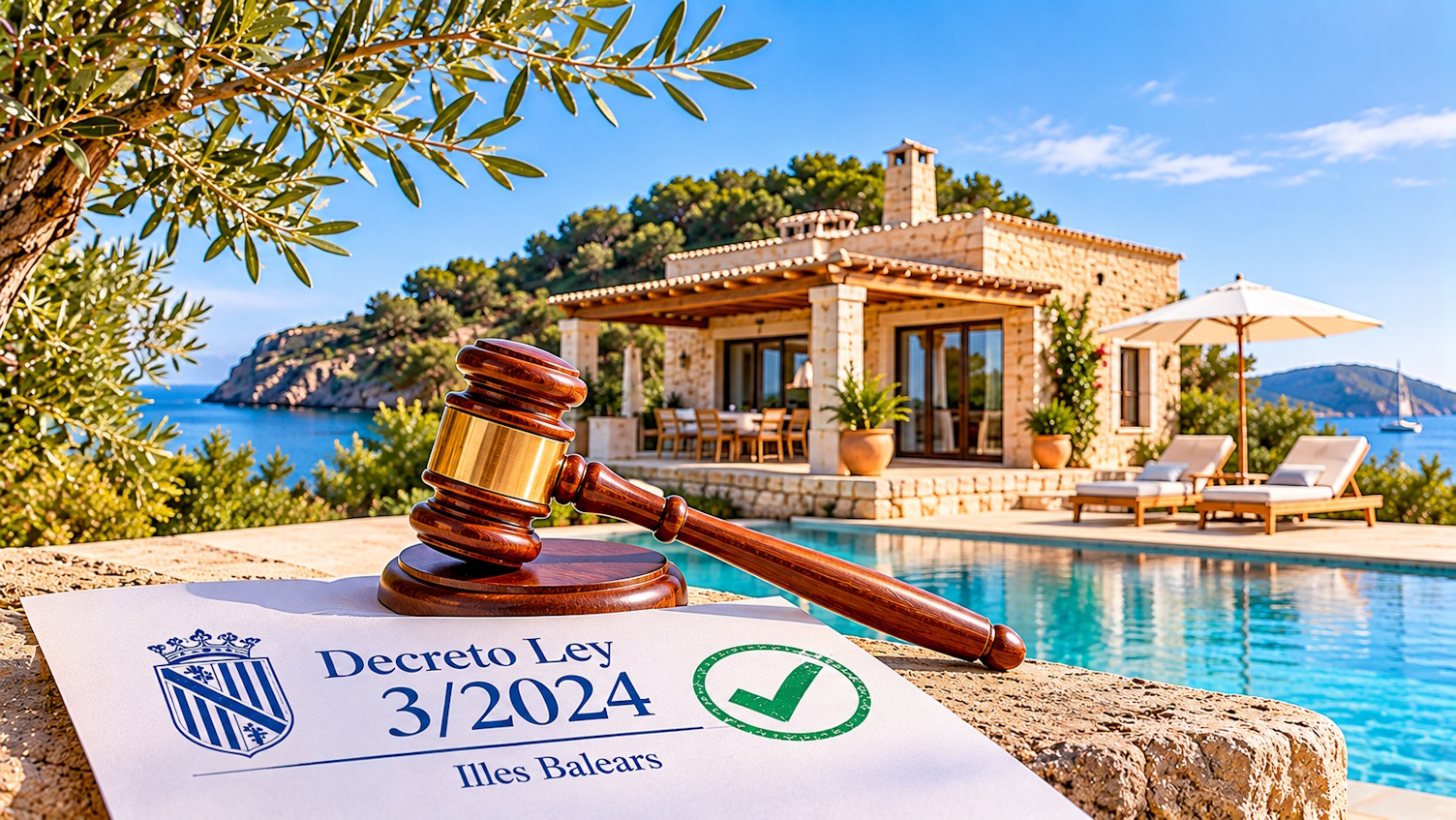
With Decree-Law 3/2024 (published on 24 May 2024), the Balearic Government passed an extraordinary regulation. This law allows for the retrospective legalisation of urban planning irregularities in buildings, structures, installations, and uses on rural land (suelo rústico), provided that the infractions have prescribed and the administration can no longer take legal action against them.
What exactly can be legalised?
The regulation applies to buildings and extensions erected without a building permit that are consequently in the status of "out of planning compliance" (fuera de ordenación). The prerequisite is that the construction works were completed at least 8 years prior to the entry into force of the law in May 2024.
This includes, among other things:
- Extensions of residential buildings and outbuildings
- Retrospectively built swimming pools
- Covered terraces, verandas, and pergolas
Deadlines and Staggered Special Fees
A strict timeframe of a maximum of 3 years (until May 2027) applies to filing the legalisation application. In addition to the regular municipal taxes and licence fees for a new building project, a statutory special fee based on the value of the structures to be legalised must be paid. The amount depends on the date of application submission:
- 1st Year (until May 2025): Special fee of 10% of the value to be regularised
- 2nd Year (until May 2026): Special fee of 12.5% of the value to be regularised
- 3rd Year (until May 2027): Special fee of 15% of the value to be regularised
Social discount: For annual incomes below €33,000, the law grants a 50% discount on the special fee; for incomes up to €52,800 per year, the discount is 25%.
Important Requirements & Sustainability Obligations
Legalisation does not happen automatically upon payment of a fee. The legislature links the procedure to clear conditions:
- Technical Execution Project: An architect must submit a project that complies with current safety and building regulations.
- Ecological and Energy Adaptation: The property must undergo mandatory upgrades with water-saving measures (e.g. construction of a rainwater cistern or modern wastewater treatment plant) and/or energy efficiency improvements (e.g. photovoltaic system or insulation).
- Permanent Prohibition of Tourist Rentals: Properties that benefit from this legalisation law can never obtain a licence for tourist rentals (ETV). This restriction is explicitly registered in the Land Registry (Registro de la Propiedad).
Exceptions and Restrictions
Not all structures are covered by this law. Legalisation is excluded for:
- Agritourism establishments and rural hotels with illegal constructions
- Structures located in public protection zones or on expropriated land
- Buildings on protected rural land (e.g. ANEI): Extremely strict special rules apply here. Legalisation on protected land is only possible if the structures were built prior to the entry into force of the Spatial Planning Law on 29 May 2014 (or prior to 10 March 1991 for areas subject to nature conservation law).
Conclusion: The Window Closes After 3 Years
After the three-year period expires in May 2027, prescribed irregularities can no longer be legalised under this procedure. For owners, this law presents a unique opportunity: retrospective legalisation ends the legal uncertainty of the fuera de ordenación status, ensures full compliance with the Land Registry (Registro de la Propiedad), and leads to a significant increase in the property's market value, enabling smooth future sales or bank refinancing.
Important Practical Note: 28 May 2027 is the absolute deadline for the submission of the complete application to the relevant Town Hall (Ayuntamiento). As the application requires a complete architectural execution project including environmental and sustainability certificates, the project should be commissioned well in advance.
All information is supplied without liability!




