


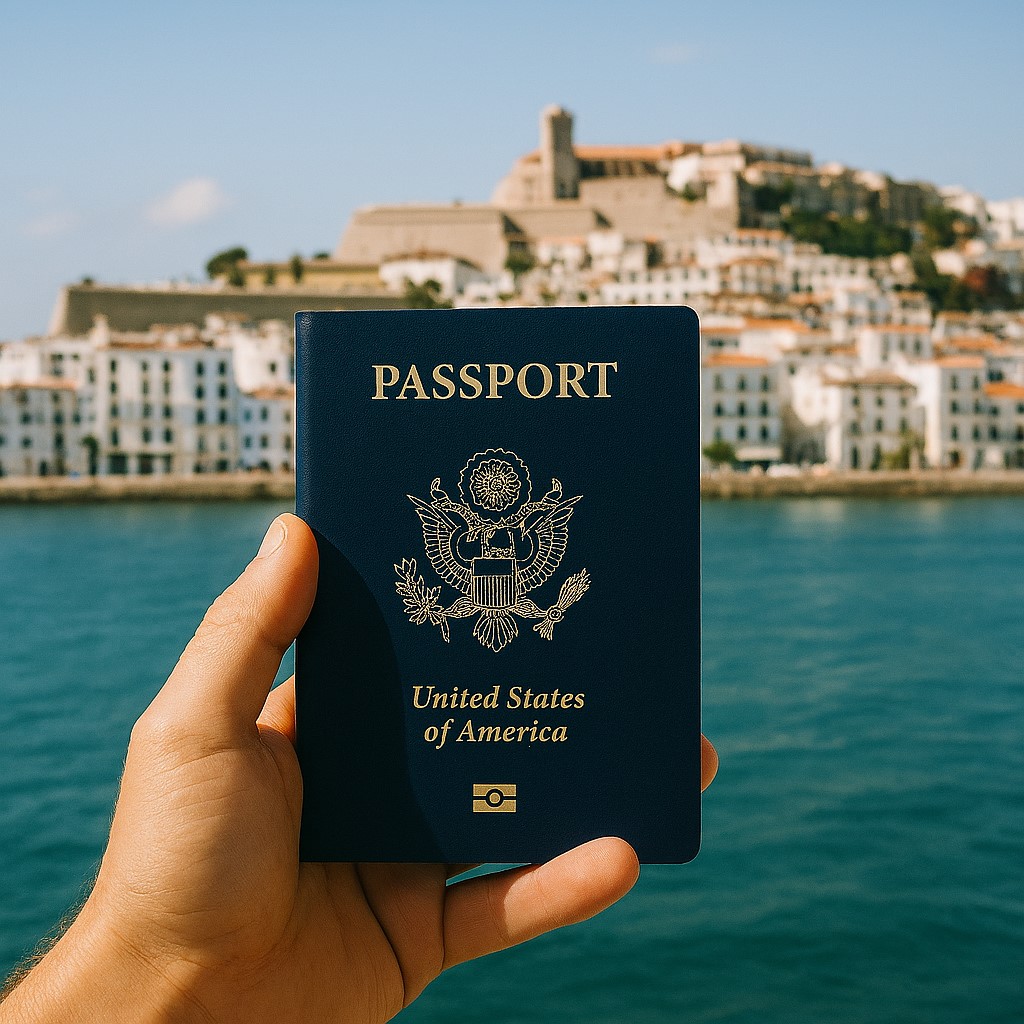
Ibiza has become one of the most attractive international destinations for U.S. buyers seeking exclusivity, legal security, and a sophisticated Mediterranean lifestyle. The island blends natural beauty, privacy, contemporary architecture, world‑class gastronomy, and a well‑established international community. In addition, its real estate market is solid, limited, and highly competitive, making it a strategic long‑term investment.
Although Spain eliminated the Golden Visa in 2025, U.S. citizens can still purchase property without restrictions and access other residency options if they wish to spend more time in the country. This guide provides a clear buying process, updated legal and tax insights, and a premium overview of Ibiza’s unique appeal.
1. How to Buy a Property in Ibiza: Step‑by‑Step Guide
1. Choose the Ideal Area
Ibiza is made up of very defined micro‑markets, each offering a distinct lifestyle:
- Es Cubells, Vista Alegre, Porroig: ultra‑exclusive, designer villas, maximum privacy.
- Santa Gertrudis, San Lorenzo, San Rafael, San Mateo, San Juan: authentic fincas, tranquility, slow‑luxury living.
- Jesús, Talamanca, Marina Botafoch, Eivissa, Playa d’en Bossa: urban lifestyle, marinas, restaurants, premium services.
- Santa Eulalia and surroundings: family‑friendly, local life with international comfort.
- San José area: close to beach clubs and the airport, while still offering nature and protected areas such as Las Salinas, plus world‑famous sunsets.
- San Antonio area: youthful atmosphere, growing development, exclusive marina, and all types of nautical activities.
For U.S. buyers, this segmentation makes it easier to find an environment that matches their priorities: privacy, sea views, proximity to services, or a more rural lifestyle.
2. Obtain the NIE
This is the equivalent of a tax identification number. It is mandatory for any real estate transaction. It can be requested in the U.S., in Ibiza, or through a legal representative. It is advisable to apply early, as processing times may vary. (For more details: https://lasanclas-ibiza.com/blog/en/info-nie-number-ibiza/)
3. Open a Bank Account in Spain
This simplifies payments, taxes, and utilities. Many banks allow remote account opening, which is especially useful for international buyers.
4. Request the Military Permit
This is a permit issued by the Ministry of Defense for purchasing properties located in rural or protected areas of Ibiza. It ensures that the transaction does not affect areas sensitive to national defense. Urban areas are usually exempt, but verification is always recommended.
It is required for all non‑EU buyers, including U.S. citizens, in order to register the property in the Land Registry.
It is advisable to request it early in the buying process, as it may take several months.
5. Due Diligence: A Critical Step in Ibiza
Due diligence in Ibiza is more exhaustive than in many U.S. states due to:
- Strict regulations on rural land
- Homes with tourist rental history
- Specific urban planning limitations
A specialized Ibiza attorney will review:
- Land Registry records
- Liens or encumbrances
- Actual urban planning status and available documentation
- Energy certificates (For more details: https://lasanclas-ibiza.com/blog/en/energy-certification-when-buying-or-selling-a-property/)
This step is essential to ensure full legal security.
6. Deposit Contract (Contrato de Arras)
This works similarly to an earnest money deposit. Typically, 10% is paid upfront, and deadlines and conditions are established. Due to high demand in Ibiza, this step often moves quickly. (For more details: https://lasanclas-ibiza.com/blog/en/info-real-estate-purchase-contracts-ibiza/)
7. Public Deed Before a Notary
The notary acts as a guarantor of legality – similar to a closing attorney but with greater public authority. The remaining balance is paid at this stage. (For more details: https://lasanclas-ibiza.com/blog/en/info-public-sales-purchase-deed-ibiza/)
The same notary can take care of preparing the D2A forms for the buyer prior to signing the deed and registering them, as non-resident foreigners are required to declare real estate investments in Spain exceeding €500,000 (for more details, see the article: https://lasanclas-ibiza.com/blog/en/form-d2a-and-d2b-declaration-of-foreign-investments-and-divestments-in-real-estate-in-spain/)
8. Land Registry
The attorney registers the deed, granting full legal protection against third parties. (For more details: https://lasanclas-ibiza.com/blog/en/info-land-registry-ibiza/)
2. Key Legal Aspects for U.S. Buyers
No Restrictions for Foreigners
U.S. citizens can purchase any type of property in Ibiza without limitations.
End of the Golden Visa
Although Spain eliminated the Golden Visa in 2025, U.S. citizens can still buy property freely and access other residency options if they wish to spend more time in Spain.
Since 2025, purchasing property no longer grants automatic residency. However, owning property demonstrates financial solvency and facilitates other immigration procedures.
Current Residency Options for U.S. Citizens
• Non‑Lucrative Visa (NLV)
Allows living in Spain without working. Requires proof of sufficient income or savings. Ideal for retirees or individuals with passive income.
• Remote Work Visa / Digital Nomad Visa
Highly attractive for U.S. professionals working for foreign companies.
Key benefits:
- Live and work from Spain
- Free movement within the Schengen Area
- Residency permits for family members
- Renewal for 2–3 years
Requirements:
- Remote work or international professional activity
- Sufficient income
- University degree or equivalent experience
- Clean criminal record
• Entrepreneur Visa & Highly Qualified Professional Visa
The Entrepreneur Visa is for business owners who can demonstrate job creation, innovation, or economic impact in Spain, granting residency for the investor and family. The Highly Qualified Professional Visa applies to individuals in executive roles within Spanish companies.
• Residency Through Business Investment (Non‑Real‑Estate)
Although the real‑estate Golden Visa is gone, business investment remains valid. Residency can be obtained through significant investment in Spanish companies, funds, or strategic projects.
• Residency Through Employment Contract
Requires a job offer in Spain and the corresponding employer‑led immigration process.
3. Taxation in Ibiza for U.S. Buyers
Both during the purchase process and afterward as a property owner, several taxes and fees must be considered.
Taxes at the Time of Purchase
These are calculated on top of the property price and paid at closing:
- New construction: VAT (10%) + Stamp Duty (1–1.5%)
- Resale properties: Transfer Tax (8–13% in the Balearic Islands, depending on purchase price)
- Notary, registry, cadastre, and administrative fees: approx. 1–2%
(For more details: https://lasanclas-ibiza.com/blog/en/info-taxes-purchase-costs-ibiza/)
Annual Taxes in Spain
Every property owner must pay annually:
- IBI (Property Tax)
- Local fees and waste collection
- Non‑Resident Income Tax: If a foreigner owns a home in Ibiza and is not a tax resident in Spain, they must file this tax annually using Form 210.
Taxation in the United States
U.S. citizens are taxed on worldwide income, meaning the U.S. requires reporting of all global assets, including property in Spain.
However, thanks to the Spain–U.S. Double Taxation Treaty, double taxation is avoided:
- Taxes are paid first in Spain (where the property is located).
- You then declare in the U.S., applying the Foreign Tax Credit for taxes already paid in Spain.
4. Why Ibiza Is a Strategic Decision for U.S. Buyers
1. An Exclusive and Limited Market
The island cannot expand, and urban planning regulations are strict. Supply is scarce and stable, favoring long‑term appreciation.
2. Premium Mediterranean Lifestyle
Ibiza offers:
- A climate that sells itself: over 300 days of sunshine, mild winters, and warm, non‑extreme summers.
Winter: 12–15 °C (54–59 °F), perfect for enjoying terraces and outdoor living. Summer: 28–32 °C (82–90 °F), with a refreshing sea breeze and stable weather. - Turquoise-water beaches
- International‑level restaurants, including Michelin‑starred options
- Wellness, yoga, and nature
- Privacy and safety
- Excellent seasonal air connectivity
A perfect balance of luxury, authenticity, and quality of life.
3. High‑End Architecture and Design
Contemporary villas, restored fincas, signature projects, and properties with panoramic views. The quality standard is especially high in the luxury segment.
4. Established International Community
Ibiza attracts buyers from the U.S., the U.K., Germany, Switzerland, and Nordic countries. The island is cosmopolitan, open, and multicultural.
For families, there are excellent international and bilingual schools: Morna International College, Lycée Français International d’Ibiza, Colegio Mestral.
5. An Investment That Combines Asset Value and Lifestyle
Ibiza is not just a financial investment—it is a place to live, unwind, and enjoy the Mediterranean in a highly cosmopolitan environment.
CONCLUSIONS
Buying property in Ibiza as a U.S. citizen is a clear, secure, and highly attractive process. Although the Golden Visa no longer exists, the island continues to offer an exclusive, stable market supported by a solid legal system and an incomparable lifestyle.
