 English
 Español
 Deutsch














Who Is a Resident and Who Is a Non-Resident?
- Spanish tax residency is triggered automatically by spending over 183 days per calendar year in Spain or having primary economic or familial interests here.
- Administrative registrations such as obtaining a NIE, enrolling on the municipal padrón, or acquiring real estate do not automatically confer tax residency.
- Tax residents are liable for Spanish personal income tax (IRPF) on worldwide assets and income, with no partial-year option available.
- Non-resident owners are taxed solely on Spanish-sourced income and must declare deemed personal use annually via Modelo 210.
- Non-EU immigration limits such as the Schengen 90/180-day rule operate independently of statutory fiscal residency criteria.
One of the most common questions we hear from international buyers is surprisingly simple: “When do I officially become a resident of Spain?” The answer matters more than most people realise — it determines which taxes you pay, which forms you file, and how your Ibiza property (and worldwide income) is treated by tax authorities.
The key point to understand is that “residency” in Spain usually refers to tax residency (residencia fiscal). It is completely distinct from holding a residence permit, registering on the town hall register (padrón), or spending your summers on the island.
How Do You Become a Tax Resident in Spain?
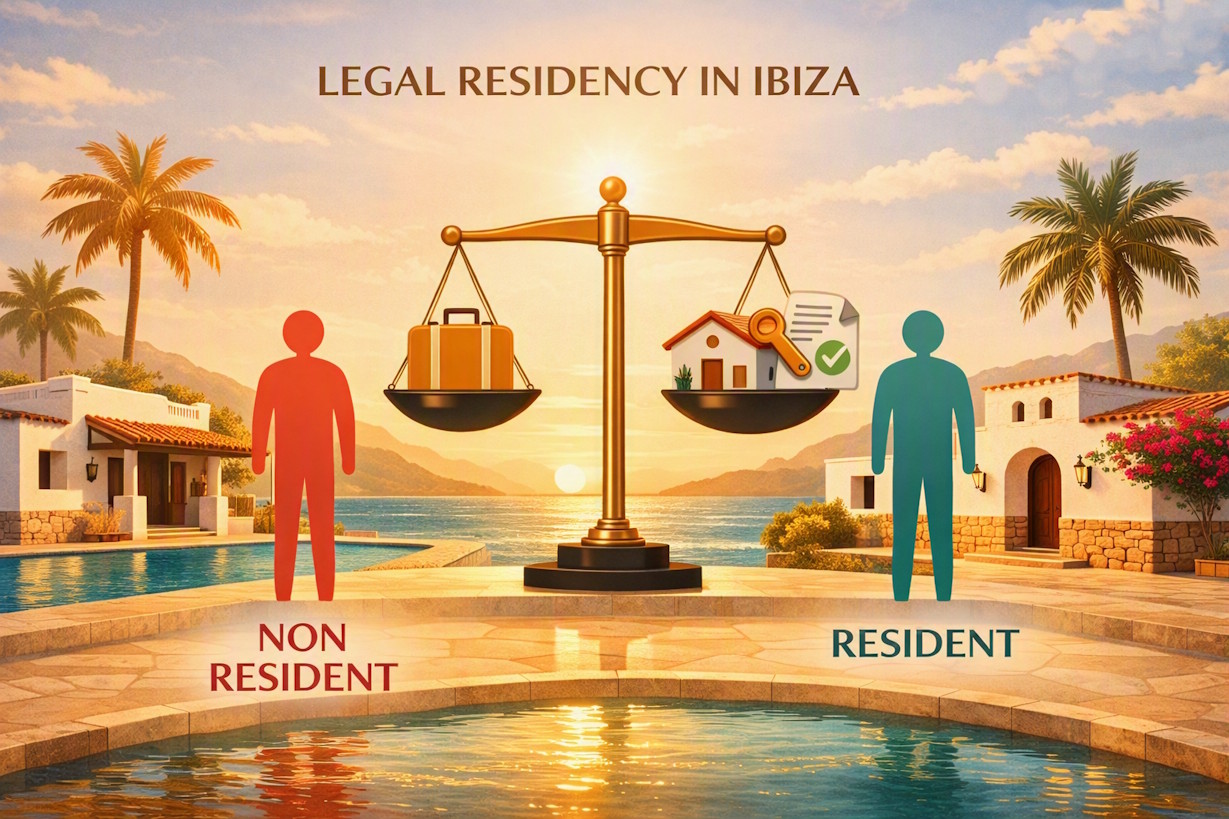
You are automatically considered a Spanish tax resident if you spend more than 183 days in Spain during a single calendar year, or if your primary economic or family interests are based here.
Key details to keep in mind regarding these rules:
- The 183-Day Rule: Counted across a single calendar year (1 January to 31 December). Short trips abroad do not pause the clock unless you can formally prove tax residency in another country.
- Economic Center of Interests: Even if you spend fewer than 183 days in Spain, you may still be deemed a tax resident if the main base of your business, employment, or investments is located here.
- Family Presumption: Unless proven otherwise, you are presumed tax resident if your spouse (not legally separated) and dependent minor children habitually live in Spain.
- Full Calendar Year: Spanish tax residency applies to the entire calendar year — there is no partial-year tax status.
What Common Documents Do NOT Make You a Tax Resident?
Holding Spanish administrative documents or owning local property does not automatically make you a tax resident of Spain.
It is important to distinguish tax residency from common administrative paperwork:
- A NIE Number: A tax identification number for foreigners needed for any transaction, but it has no impact on tax status.
- The Padrón: Registering at the local town hall helps with municipal services, but does not equal tax residency.
- A Residence Card (TIE or EU Certificate): Confirms your legal right to reside in Spain, but you can hold a residence permit and still remain a tax non-resident.
- Property Ownership: Owning real estate triggers specific non-resident taxes, but ownership alone does not make you a resident.
What Are the Tax Differences for Resident vs. Non-Resident Property Owners?
Spanish tax residents are taxed on their worldwide income, while non-resident property owners are only taxed on Spanish-sourced income and property.
If You Are a Spanish Tax Resident
You file annual personal income tax (IRPF) on your worldwide income and assets, regardless of where they are earned or held.
If You Are a Non-Resident Property Owner
You pay Non-Resident Income Tax (IRNR). For property owners, two key obligations apply:
- Personal Use (Imputed Property Tax): If you do not rent out your property, Spain charges a small annual tax on "imputed income" based on the property’s cadastral value (valor catastral). This is filed annually using Modelo 210.
- Rental Income & Sales: If you rent your property, income must be declared. When selling, non-resident sellers pay capital gains tax.
Does Brexit or the Schengen 90-Day Rule Affect Tax Residency?
No, the Schengen 90/180-day immigration rule for non-EU citizens is completely separate from tax residency rules.
Staying under 90 days prevents visa overstays for non-EU passport holders (like UK or US citizens), but immigration status and tax residency operate on two entirely different legal tracks. Furthermore, Spain maintains Double Tax Treaties with most countries (UK, US, Germany, France, etc.) to prevent double taxation through official certificates of tax residency (certificado de residencia fiscal).
Summary: Resident vs. Non-Resident at a Glance
| Feature | Tax Resident | Non-Resident |
|---|---|---|
| Time Spent in Spain | Over 183 days / year (or main economic/family center) | Under 183 days / year, with no economic tie |
| Tax Scope | Worldwide income & global assets | Spanish-sourced income & property only |
| Property Tax (Personal Use) | Included in annual tax return (IRPF) | Annual Modelo 210 return |
| Rental Income | Declared via IRPF | Declared via Modelo 210 |
Tax residency is determined by objective facts, not paperwork or intentions. At inmobiliaria LAS ANCLAS, we ensure all our buyers are introduced to experienced local legal and tax professionals before finalizing a transaction. If you would like a personal introduction to a qualified tax adviser or legal team on Ibiza, please contact us.
Disclaimer: This article is provided for general informational purposes only and does not constitute tax or legal advice. Always consult a certified Spanish tax adviser (gestoría or abogado) regarding your personal financial circumstances.
All information is supplied without liability!




