 English
 Español
 Deutsch















Land Registry in Ibiza: Why Registering Spanish Property Is Essential
- The Registro de la Propiedad provides essential legal title protection for property buyers in Spain.
- Unregistered property purchases prevent mortgage approval and leave buyers exposed to third-party claims.
- Registration requires securing an asiento de presentación, paying transfer taxes, and deed filing by a gestoría.
- Understanding the legal role of the Land Registry versus the administrative function of the Catastro is vital in Ibiza.
Spain has a legal quirk that often surprises international buyers: you can technically complete a property purchase with just a private contract — without official registration. In practice, virtually every experienced solicitor and real estate professional will tell you the same thing: always register. Here's why.
What Is the Spanish Land Registry (Registro de la Propiedad)?
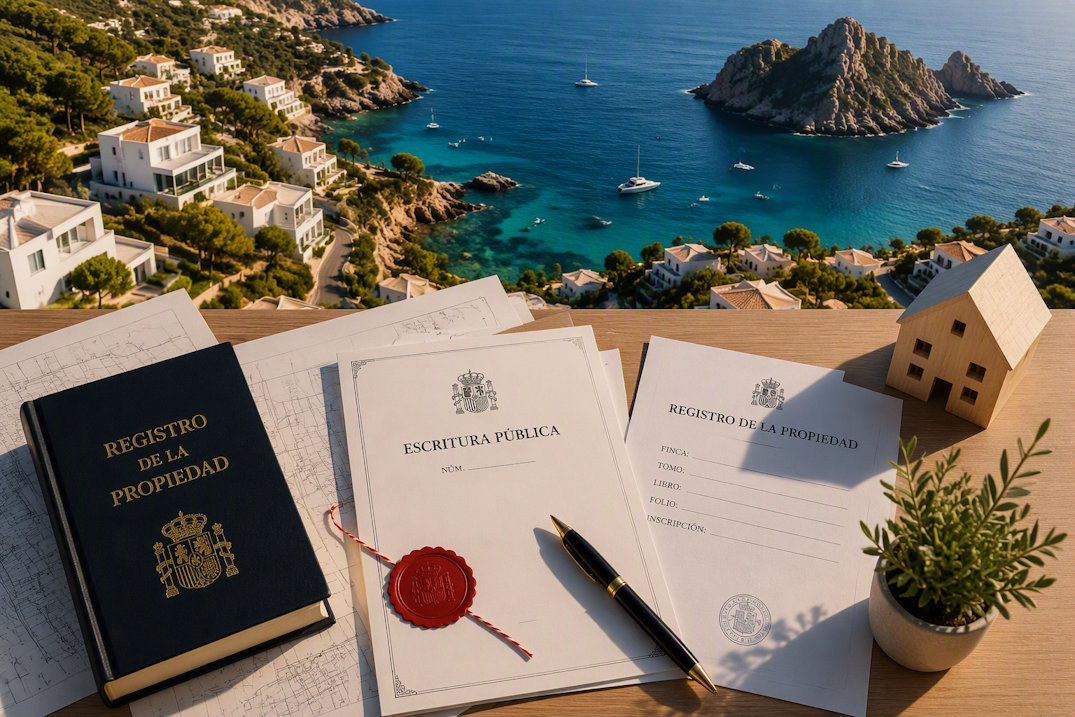
The Registro de la Propiedad is Spain's official public register that legally documents property ownership, physical boundaries, and any charges, mortgages, or encumbrances. It operates under the Spanish Ministry of Justice and is managed by licensed registrars (registradores de la propiedad) across the country.
Before signing any deed, your legal representative will request a Nota Simple — an official registry extract that confirms the legal owner, any outstanding debts or charges, and the property's official description. Obtained digitally through Spain's Sede Electrónica platform, this document makes due diligence faster and more transparent than ever for buyers.
Is Property Registration Mandatory in Spain?
No, property registration in Spain is not legally mandatory, but it is essential for legal protection. Without registering your purchase in the Land Registry, your ownership lacks full legal protection against third parties.
Failing to register carries significant risks:
- Risk of Third-Party Claims: A creditor of the previous owner could potentially pursue a legal claim or attachment against the property.
- Limited Legal Recourse: You would have limited legal recourse if an ownership dispute arose with third parties.
- No Mortgage Approval: Spanish banks will not grant a mortgage on an unregistered property — registration is a strict prerequisite for securing finance.
- Complicated Resale: Reselling the property in the future becomes significantly more complicated and risky for prospective buyers.
Registration is your legal shield. Once your title is inscribed in the Registro de la Propiedad, your ownership is fully protected. In fact, this protection begins the moment the Notary submits an electronic preliminary notification (asiento de presentación) immediately upon signing the deed.
How Does the Property Registration Process Work in Spain?
Registration takes place after the purchase is finalised at the notary's office. The steps are straightforward, but timing is crucial:
- Electronic Notification: Immediately after completion, the Notary electronically notifies the Land Registry. This secures a priority entry (asiento de presentación) that immediately locks out any competing claims or charges by third parties.
- Tax Payment Within Deadline: All relevant taxes — Property Transfer Tax (ITP) for resale properties, or VAT (IVA) and Stamp Duty (AJD) for new builds — must be paid within a strict deadline of 30 calendar days from signing the deed.
- Deed Submission: Your solicitor or gestoría submits the tax-stamped public deed (escritura de compraventa) to the Land Registry for final inscription.
- Final Inscription: Full registration typically takes between two and six weeks from the final submission of documents.
How Much Are Land Registry Fees in Spain?
Land Registry fees are state-regulated on a sliding scale, typically ranging between 0.1% and 0.2% of the declared property value — a modest investment for absolute legal security.
Digital Filing and Faster Registration
Spain's digital registry infrastructure allows notaries, gestorías, and legal teams to submit deeds and handle taxes electronically. This eliminates administrative delays compared to paper filing. For international buyers working with an experienced local solicitor or gestoría, the transaction moves smoothly, securely, and with complete transparency.
What Is the Difference Between the Land Registry (Registro) and the Cadastre (Catastro) in Spain?
The Land Registry (Registro de la Propiedad) guarantees legal ownership, whereas the Cadastre (Catastro) is purely an administrative tax database. These two terms must never be used interchangeably.
The Cadastre is managed by the Ministry of Finance and records physical property metrics (size, boundaries, usage) solely for local tax assessments like property tax (IBI). The Land Registry is the only authority that legally confirms legal title and rights. Discrepancies between the Cadastre and Land Registry are common (especially in Ibiza) and must be flagged and resolved by your lawyer prior to completion.
At inmobiliaria LAS ANCLAS, every transaction we facilitate includes a thorough Land Registry review as standard practice. If you would like to understand how property registration fits into your overall Ibiza purchase timeline — or need guidance on appointing an independent legal team — we are here to assist you.
All information is supplied without liability!




