 English
 Español
 Deutsch










What Is the Cédula de Habitabilidad?
- The cédula de habitabilidad certifies that a residential property in Ibiza complies with mandatory health, safety, and habitability standards.
- Under the 2024 Balearic regulatory updates, first occupancy for new builds and major refurbishments is handled directly by local town halls (Ayuntamientos) as a licencia de primera ocupación.
- Standard certificates remain valid for 10 years and must be renewed through the Island Council (Consell Insular d'Eivissa) via a certified architect.
- Older properties built before 1 March 1987 without an original certificate may apply for a default certificate (cédula de carencia), provided there are no planning infractions.
- A property without an active cédula can still be legally sold in Ibiza if explicitly declared and accepted by both parties before a notary in the deed of sale (escritura pública).
Certificate of Occupancy
The cédula de habitabilidad is an official certificate confirming that a property meets the minimum habitability requirements for residential use, including suitable dimensions, sanitary facilities, and installations. In the Balearic Islands, it is issued by the Island Council (Consell Insular).
Historically, the certificate was required to connect a property to public utilities such as water, electricity, and sewerage, and it remains closely linked to the first registration of newly built properties in the Land Registry.
What Information Does It Contain?
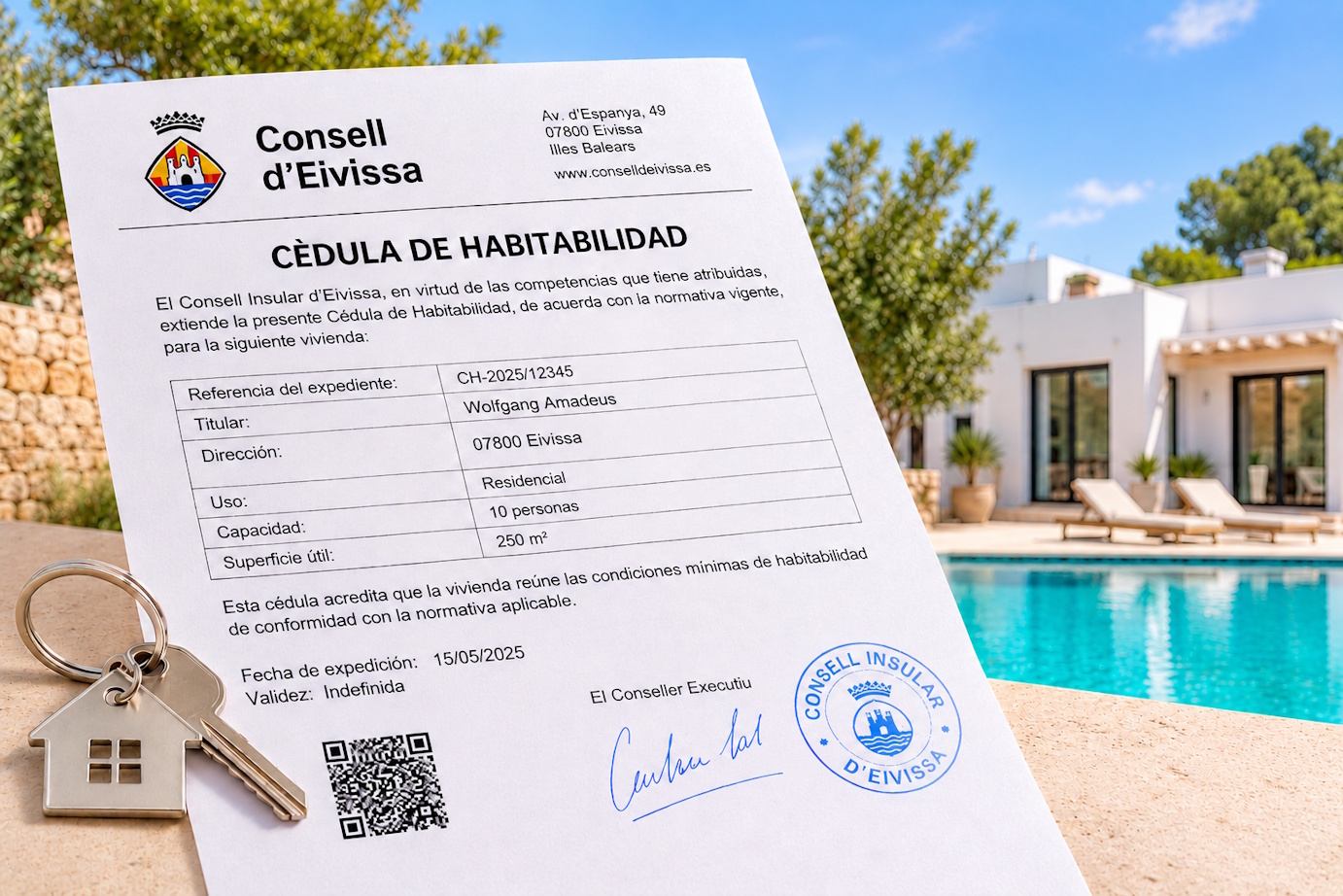
A cédula de habitabilidad normally includes:
- The maximum permitted occupancy
- The address and location of the property
- The municipality
- The file reference number and year of issue
- The validity period
- The identity and professional title of the issuing technician
Which Types Exist Today? (The 2024 Update)
In 2024, the process was streamlined across the Balearic Islands to eliminate administrative redundancy. Previously, a new build required both a municipal license and a second certificate from the Island Council (Consell Insular). Today, the types are divided as follows:
- Licencia de ocupación / primera utilización (Certificate of first occupancy): Replaces the former cédula de primera ocupación issued by the Island Council. It is required for newly completed homes, major extensions, substantial renovations, or changes of use. This is now granted directly by your local municipality (Ayuntamiento) as your sole primary occupancy document.
- Cédula de habitabilidad de renovación ( Renewal Certificate): Required when an existing cédula expires (valid for 10 years) and the property has not undergone major building works. Renewal applications are still processed through the Island Council.
- Cédula de habitabilidad de carencia (Default Certificate): A special certificate for older properties completed before 1 March 1987 that never originally received a cédula. In this case, it must be proven that the property is not subject to any ongoing urban planning infringement proceedings and that the property has not undergone any extensions or comprehensive refurbishments since that date which would have required a modern major building permit.This is processed through the Island Council.
Validity Period
In the Balearic Islands, a standard cédula de habitabilidad is valid for 10 years from its date of issue. It does not renew automatically; once expired, a formal renewal application must be submitted by a qualified architect or technical architect.
What If the Property Does Not Have a Certificate of Occupancy (Cédula de Habitabilidad)?
First of all, there is no need to worry: the absence of a valid Certificate of Occupancy does not necessarily mean that a property cannot be sold.
In the Balearic Islands, there are properties which, due to specific urban planning or administrative circumstances, cannot obtain a new Certificate of Occupancy. Nevertheless, these properties can still be legally transferred through a sale.
In such cases, the status of the certificate is expressly stated in the public deed of sale, and the buyer, having been fully informed, expressly accepts its existence or absence at the time of signing before a notary.
Therefore, the lack of a Certificate of Occupancy should not automatically be a cause for concern or prevent a transaction from taking place. What matters is understanding the property's actual situation, documenting it correctly, and ensuring that both buyer and seller proceed with complete transparency.
In addition, documents such as a Certificate of Antiquity (Certificado de Antigüedad) can provide valuable legal certainty by confirming how long the building has existed and which parts of the construction have become legally consolidated over time, giving the buyer a clear understanding of the property's planning status.
In Summary
Not all properties without a Certificate of Occupancy are able to obtain a new one, but many can still be sold without any issue. The key is proper disclosure and documentation of the situation, which is expressly reflected and accepted in the public deed of sale. There is no reason for panic; each property simply needs to be assessed on its individual circumstances.
For more expert guidance, contact inmobiliaria LAS ANCLAS today.
All information is supplied without liability!




